90s Flowchart
- Comments:
- here.
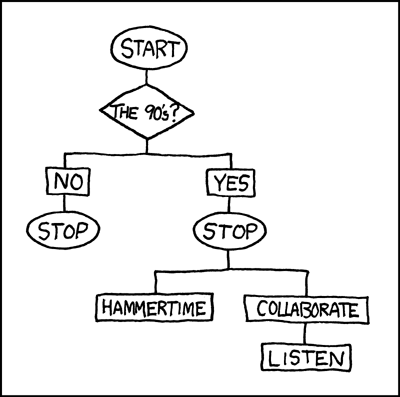 xkcd - A webcomic of romance, sarcasm, math, and language - By Randall Munroe
 This one gets a gig because it’s funny. I wonder if they noticed?
 This one gets a gig because everyone knows it’s true. Except in my case, of course.
 This one gets a gig because the poster didn’t pay enough postage.
 This one gets a gig because I’m an apostrophe nazi. Does he mean his friend has multiple wives, as it is written. Or does he really mean friends’ wives. I mean, he could be in Utah.
 This one gets a gig because we used to do the same thing, years and years ago. Our phone number was one digit different to a Hospital, and we used to have people ringing up at all hours looking for it, so we started answering with “Hello, Northern Community Hospital.” But we never managed to answer like that when it was a phone call for the hospital.
Since I share my iTunes music, or more specifically, the music files themselves between a variety of clients, I’m not really interested in having iTunes find the artwork for me. This is mainly because the data is stored in the iTunes folder, not the MP3/AAC files themselves. So, I’d rather go through and find the artwork and add it manually. Often, this will be scanning the original CD cover, if it’s in good enough condition. With the inclusion of the artwork view in the iTunes main window, this task is much, much easier. Before, I had to use some crazy AppleScripting to find the tracks missing artwork; now I just have to scroll down until I find the tracks that are missing it. And then hunt around for the CD, or google for it.
I had a bit of an issue with my NSLU2 tonight. I wasn’t able to install coreutils. It was complaining that busybox-links was installed, and it was clashing. However, I didn’t have it installed, and no amount of ipkg remove busybox-links, or ipkg -force-overwrite install coreutils was working. Then I came across Slugging, which shows how to deal with this exact problem: remove the _busybox _and busybox-links stanzas from the file /usr/lib/ipkg/status. Thanks, z0mbi3. Even though I hate l33tsp33k.
So, Apple has released a couple of new bits and pieces. I’m not going to mention the Apple iPhone, as it is unlikely to be available where I live, and the other two are a bit more interesting for me. The first one I noticed was the Apple TV. This is an AU$449 device that hooks up to (only widescreen) televisions, and allows you to watch video, view pictures and listen to audio that is stored on your Mac or PC. Which is exactly what I currently use XboxMediaCentre for. However, from a couple of things I’ve read on the Apple website, I won’t be getting one soon. I think it acts like an iPod, and requires syncing. This because that ’s’ word is mentioned, and because it also talks about ‘up to 8750 songs,’ and since it has a 40GB hard drive, that sounds about how many tracks you could store on it. I don’t store any media on the Xbox - it’s all stored on a seperate media server. Why waste space by having duplicates of large files? It gets even worse if you look at Movies and TV programs. It may stream movies, I do recall seeing that somewhere. Plus, I may have to re-encode some video files, as AppleTV might not play everything, like VLC and XBMC do. The other feature that I think is missing is recording from TV. This makes it a deal-breaker for me. That’s the only functionality I don’t have with XBMC, and is the reason I’m going to consider getting a Mac Mini to replace it. If Apple don’t come up with something better. Admittedly, it looks much nicer than an Xbox, but it won’t play all of my Xbox games, either. Resolution-wise, the Apple TV might be a step ahead of the Xbox. I’m not sure what resolution XBMC can output, it may be 1080i, I’m not sure. (Note: after research, you can output this res with even a standard Xbox, but you need to get a special hi-res cable). • The other product Apple released is somewhat interesting. Airport Extreme. Basically, it’s an 802.11a/b/g/n wireless router. It has a couple of other key features, however. It also has a USB port, but it’s not a device-side port. Instead, it allows Hard Disk drives, Printers and the like to be plugged in. This would mean that the one device could replace (and upgrade!) my router, and my NSLU2 file server. The bonus is that it can easily handle multiple hard drives, unlike the NSLU2, which I’m probably going to have to install a different OS onto to get this functionality. At AU$259, (IIRC: $229 educational), it appears pricey, but replaces a NAS device, Print Server, and a wireless router. And beefs up the speed to 802.11n, which is 10x faster than my current router. Disadvantages of this over my current setup? I currently use my NSLU2 as a torrent client, and this functionality is unlikely to be built into the Airport Extreme! • What’s next? I’m hoping to see what happens when some real users get their hands on these devices. I’d suggest they might be running a cut-down OSX, or perhaps Linux/BSD or something, in which case they should be eminently hackable. For instance, it might be possible to use the AppleTV hardware, plug in an EyeTV, and bingo, PVR. Much cheaper than a Mac Mini, but with all of the desired functionality. And, turn off Syncing of iTunes library, and instead just look for files on a Server, and stream audio as well as video. As for Airport Extreme, it’s likely that this is a less powerful beast, but might provide better performance than my old NSLU2, which chugs along a bit when trying to grab more than one torrent at a time. (Don’t mention that you should queue torrents, this is for low-rate torrents, and the software I use doesn’t queue).
I’ve ripped a fair chunk of my CDs to AAC format, using iTunes. I used AAC 128kbps, but since I’ve just bought a new 250GB Hard Drive to use for Movies/Television, I can have the 160GB one used almost solely for Music (and data backups for the various computers on my network). I’m thinking of re-ripping my CDs to 192kbps AAC, which will make the files about 1.5 times their current size. I currently have 43 GB of music, but some of this is downloaded (iTunes Store and Podcasts), so the whole database won’t increase by this much. I’m also going to make some other structural changes. I’m not going to have iTunes manage my music files, just the tags inside of them. That way it will play nicer with a variety of clients. iTunes moves files around when you change the ID3 tags, so another version of iTunes, or Xbmc, or whatever, can’t find them anymore. It might mean the filenames are wrong, but I think every system I use will have a database of the tags, rather than the files themselves. I just hope the various systems update the tags when they have been changed. I’m also going to stop using my Wireless Router as my DHCP/DNS server. I just don’t like the inflexibility that Netgear’s system has in this regard. I want to be able to add static IP addresses, and have the hostnames resolve. Which I know the SpeedTouch modem did using it’s DHCP/DNS setup. And then I can isolate the wireless segment of the network a bit more. Not that that’s too much of an issue using WPA, but you never know…
Rsync Backup System | alexking.org Note to self: re-read this after the new hard drive arrives.
Hidden Threat: Alternate Data Streams Hmm. This is quite interesting. Under any Windows machine with an NTFS disk, you can hide applications inside other files: C:> type nasty.exe > plain.txt:nasty.exe You can then run this command with: C:> start plain.txt:nasty.exe Now, this might not seem like much, but this is virtually undetectable. You can add any file to another file, and even exerienced sysadmins probably won’t find it!
An even better method of getting a random (ascii) password: $ head /dev/urandom | strings -n 5 | sed 'N;s/$//;s/\n//g;s/\n//g' | sed 'N;s/$//;s/\n//g' | head -n 1 (All on one line, naturally). I had to do the two seds to make it work properly. It would have been nicer if this combined all of the lines, and then I could just trim as many chars as I wanted, but this was tricky. The head -n 1 discards any lines other than the first.
Texas environmental officials have delayed a proposed ban of biodiesel fuel in the state to allow further studying of the emissions of biodiesel blends.
Really? And the oil companies let them delay the ban?
The skeptic might say that Texas regulators passed a law that exploits the one negative aspect of biodiesel to protect the oil industry in that state.
You don’t say.